Page through the various pages for information on ear related topics.
Showing posts with label anatomy. Show all posts
Showing posts with label anatomy. Show all posts
Wednesday, November 19, 2008


Tuesday, October 16, 2007
MIT researchers discover a new hearing mechanism
An article on the Massachusetts Institute of Technology's (MIT) news website published on October 10, 2007 reported that MIT researchers have discovered a mechanism inside the inner ear that functions in a different way. For over 50 years, it has been known that sound waves inside the cochlea travel in an up-and-down manner. But the research team noted in the article has found that sound energy can also be carried by a traveling wave that moves from side-to-side. Read the article to learn more about the potential impacts of this discovery.
Click here to read the article: MIT finds new hearing mechanism
Click here to read the article: MIT finds new hearing mechanism

Credit: Ghaffari, Aranyosi, and Freeman, MIT
Tuesday, October 9, 2007
Dancing outer hair cell
 This post is just another reason why our auditory system is so fascinating. To appreciate this movie, I need to give a short explanation of some auditory structures and their role in hearing.
The cochlea is a snail-shaped structure in the inner ear (beyond your eardrum) that is the sensory organ of hearing. There are microscopic hair cells with stereocilia at the tips within the cochlea that are responsible for moving in response to vibrations. Basically, it is the motion of the sensory hair cells that allows signals to be sent to the brain via the auditory nerve and process sounds we hear.
The image on the right shows a top view of the stereocilia of an outer hair cell in the cochlea. Credit: www.neuroscience.cam.ac.uk
Hair cells are most sensitive and contract at specific frequencies. They can degenerate over our lifetime with age and can also be damaged when we are exposed to very loud sounds, which is why it is important to always protect your ears. UK Scientist, Jonathon Ashmore was able to isolate a single outer hair cell and make it dance! That's right, dance...presenting you with the DANCING OUTER HAIR CELL!
Read an explanation of movie from Ashmore's website here: http://www.physiol.ucl.ac.uk/ashmore/hairexpl.htm
Thursday, June 28, 2007
How we hear
I really doubt that you have ever had to tell your brain to hear. Luckily, we don't have to. We have the ability to hear sounds and speech instantly on a continuous basis, without ever having to stop and think about it. The ear anatomy seems simple enough from the outside, yet the auditory system and the process of hearing are both fairly complex.

It's a cool process to learn about. Our ears are composed of 3 regions with structures that work together to help us hear. These are the outer, middle and inner ear (see diagram). The sensory cells in the inner ear are responsible for sending information to the brain using the auditory nerve.
To learn about the process of hearing, check out the House Ear Institute's website: How we hear
To learn about the process of hearing, check out the House Ear Institute's website: How we hear
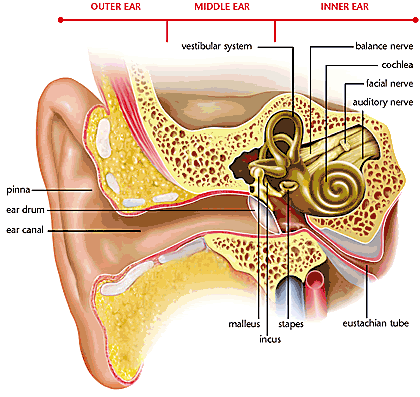
Illustration Source: MED-EL Corporation
Subscribe to:
Posts (Atom)