Thursday, June 28, 2007

What is considered too loud?

It can be surprising to find out how loud some everyday activities can be. Check out this great poster:
Noise Thermometer Poster
(be sure to zoom in for details)

Remember that possible ear damage begins to occur at 85 decibels (dB). If you are going to exposure your ears to sound levels above this level, use hearing protection: foam earplugs, high-fidelity earplugs or earmuffs.
Some factors to keep in mind when trying to determine safe and unsafe sound levels:
1. How close you are to the source of the sound
The closer you are to the source (ex. speaker), the louder and possibly more harmful the sound.
2. Duration (time) you are exposed to the sound The recommended exposure time depends on the decibel level. Check out this helpful chart:

Source: House Ear Institute (http://earbud.org/nihl.html)

Feel free to message me with questions!

How we hear

I really doubt that you have ever had to tell your brain to hear. Luckily, we don't have to. We have the ability to hear sounds and speech instantly on a continuous basis, without ever having to stop and think about it. The ear anatomy seems simple enough from the outside, yet the auditory system and the process of hearing are both fairly complex.
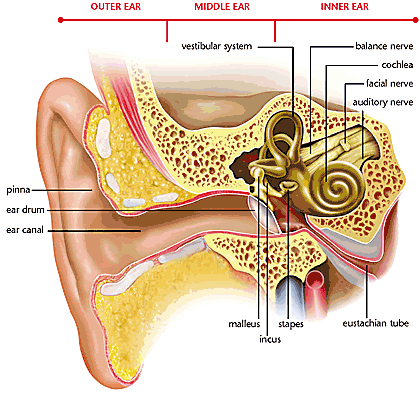
It's a cool process to learn about. Our ears are composed of 3 regions with structures that work together to help us hear. These are the outer, middle and inner ear (see diagram). The sensory cells in the inner ear are responsible for sending information to the brain using the auditory nerve.

To learn about the process of hearing, check out the House Ear Institute's website:
How we hear
Illustration Source: MED-EL Corporation

Don't have earwax removed by the "coning" method

During the presentations, a few students asked me about the "coning" procedure used to remove earwax from the ear canal. I was not very familiar with the procedure so I asked an audiologist at House Ear Institute for more information. He referred me to this website: Why Ear Candling Is Not a Good Idea.

Remember, DO NOT insert cotton swabs (ex. q-tips) inside your ear canal. Use them to clean ONLY the outer portion of your ears. Earwax is there to protect your eardrum from bacteria, dirt and dust particles and earwax will naturally migrate out of your ear canal.

Please remember that if you feel you have earwax accumulated in your ear canal, you should see a physician to have the earwax removed.

Thank you Clark students!

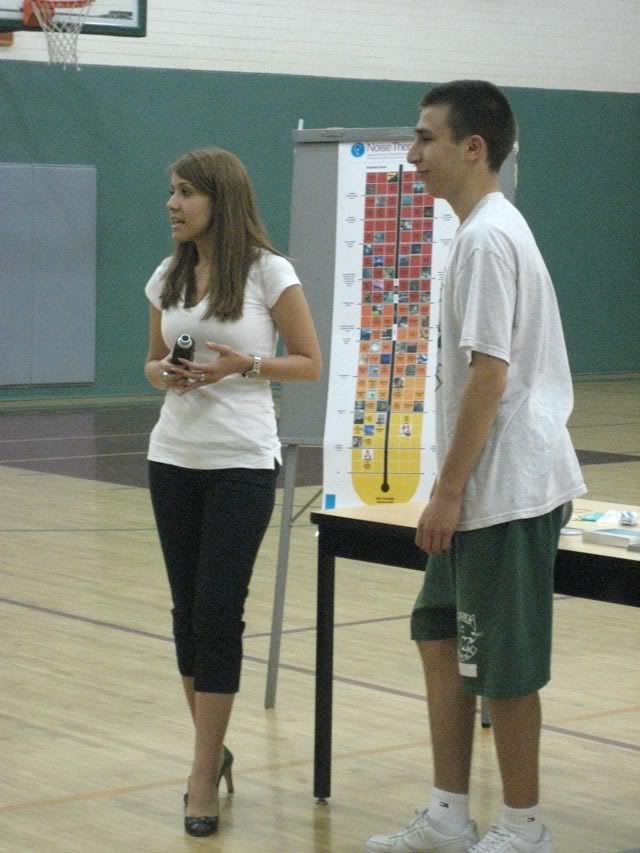
I wanted to thank all Clark Magnet students that listened to my presentation. I appreciate the fact that you were all so attentive, respectful and interested in learning about hearing conservation. There were some really great questions asked; I am impressed!

Please remember that I am here to answer any questions you may have on hearing and ear related topics. Just send me a message and I will be more than happy to reply to you.

Please be sure to check back frequently for new blog posts.

Thank you for giving me the chance to share my knowledge with you. Best of luck to everyone! :)

Etymotic Earplugs

As promised, here is a recommendation for a decent pair of musician's earplugs that you can purchase that preserve sound quality, while protecting your ears from high noise level exposure. These are less expensive than custom musician's earplugs but are high-fidelity meaning that sound quality is preserved.

This is the one I showed to the classes as an example during the Clark Magnet HS presentations on hearing conservation awareness. They come with a plastic key chain container, which makes it very convenient to carry around with you.

Etymotic earplugs website


You can buy foam plugs, similar to the ones distributed from any local drugstore.

Remember that "NNR" stands for Noise Reduction Rating. This rating will tell you the potential amount of decibel reduction the earplugs can provide, if worn properly.

Audio Demo of Noise-Induced Hearing Loss (NIHL)

In celebration of "Better Hearing and Speech Month" in May, I put together a presentation for Clark Magnet High School. I'm posting an audio clip I played from my iPod to the students. It is an simulated audio clip of what noise induced hearing loss (NIHL) may sound like.


Here is some information and the clip from Health & Safety Executive that was shared with me by a friend of mine, who is an audiologist.
------------------------
Audio Demonstration of Noise-Induced Hearing Loss


Noise induced hearing loss is irreversible damage to the ears caused by exposure to high levels of noise. This recording demonstrates how hearing is gradually lost over a working life. Do NOT adjust the volume after starting to listen to the clip.
The hearing loss simulations all include the effects of noise exposure and aging. At the end of each simulation the hearing undamaged by noise for the age can be heard.
Click on the link below to listen to the audio demonstration.
To save this demonstration to your computer - right click on the link and select 'save link as'